Home
back to top
back to bottom
Custom Search

.:: Table Of Content ::.

2012 BMW i8 in "Mission Imposible 4" Movie


2012 BMW i8 in "Mission Imposible 4" Movie

2012 BMW i8 now exists and is real in the world. BMW i8 first used in 2012, the latest film “Mission Impossible 4″. BMW i8 is used at the time went to the house of the richest people in India and at the time of the chase for the lethal control of nuclear being launched into the United States. This car is truly luxurious and elegant and looks like the car of the future. It’s amazing voice is so smooth sounding engine and luxurious interior exterior. Here are some photos of the BMW i8 in “Mission Impossible Movie 4″.


2012 Car and Concept BMW M5 Design

Following the perfect line: The BMW Concept M5.

Munich. For 25 years now, the fascinating combination of supreme driving comfort experienced in a premium upper midrange sedan and the handling characteristics of a high-performance sports car has been described by one single unmistakable model designation - BMW M5. In 1984, with the first generation of this model, the BMW M GmbH laid the foundation stone for a completely new vehicle category. The BMW M5 was the first car of its kind to offer racing-oriented high performance in a sedan that could be driven without restrictions in everyday road traffic. This unique concept developed into a remarkable success story spanning four model generations. The BMW M GmbH is now drawing the attention of racing car enthusiasts to a four-seater yet again. The BMW Concept M5, which is making its public debut at the Auto Shanghai 2011, presents itself as the latest reinterpretation of this unmistakable vehicle character.

Superior sportiness and typical M aesthetics in a BMW 5 Series Sedan format provide the basis for the exclusive BMW M5 driving experience. With each model generation, the advancements made in the development of premium sedans in terms of comfort, safety and premium ambience were accompanied by new possibilities to intensify that unsurpassed ‘M feeling’. The world premiere of the BMW Concept M5 at the Auto Shanghai 2011 gives clear signals for the continuation of this tradition. Based on the design vocabulary developed for the BMW 5 Series Sedan, the near-series concept car reflects the characteristic styling features of a BMW M automobile, with which the car’s further enhanced dynamic potential is authentically visualised.


A new high-revving V8 engine with M TwinPower Turbo Technology guarantees typical M power output. The eight-cylinder power unit delivers a spontaneous and even acceleration, which remains constant up to the highest load and is characteristic of the M feeling, in a previously unequalled dimension. At the same time, both performance and efficiency have been significantly increased in comparison to the previous engine. Numerous drivetrain innovations and other enhancements have lead to a reduction in fuel consumption and emission levels by more than 25 percent. The new engine and a seven-speed M double-clutch transmission with Drivelogic and M-specific suspension and steering create the ideal prerequisites for an unrivalled driving experience.

Typical M aesthetics: performance defines design, aerodynamics optimise performance. The athletic appearance of the BMW Concept M5 authentically expresses the engine’s superior power. The sporty and elegant look of the BMW M5 Sedan has been specifically modified using typical M design vocabulary. All specific design features are directly related to the four-seater’s outstanding performance characteristics. They were developed exclusively for the BMW Concept M5 and enhance the vehicle’s character, which is marked by high performance and supreme handling even under extreme conditions. Prominent examples of this are the large air intakes, which allow for the engine’s higher cooling requirements, as well as optimised aerodynamics thanks to a discreet spoiler located on the boot lid and a diffuser integrated into the rear apron.

The BMW Concept M5 owes its intense emotional impact to the direct relation of each detail with the technical requirements. At the same time, the concise styling of the high-performance car’s specific features creates the character of understatement that is typical of a BMW M automobile. The car’s superior appearance is underlined by the body colour Chrome Shadow. The discreet appearance of this body colour distinctively enhances the surface contours of the vehicle’s three-dimensionally modelled bodywork.


Front apron: precise airflow optimises cooling and aerodynamics. Dynamic lines and large air intakes on the front end of the BMW Concept M5 are a clear implication of the vehicle’s exceptionally sport-oriented characteristics and its engine’s outstanding power. Like on the BMW 5 Series Sedan, the contour lines on the bonnet of the BMW Concept M5 flow towards the BMW kidney grille. The upright position of the widely stretched kidney grille also signalises dynamic forward movement. The dual round bi-xenon headlights, which are complemented at the top by an accentuating light, create the road-focused look that is also characteristic of BMW M automobiles.

The front apron, which was designed exclusively for the BMW Concept M5, contributes significantly towards both the car’s athletic appearance as well as its dynamic potential. It features three large air intakes, the dimensions of which are precisely oriented towards the high cooling requirement of the engine and its ancillary components. The centre opening corresponds to the width of the BMW kidney grille, the side contour lines move away from each other as they continue downwards. This echoes the V shape between the grille and the headlights, thus emphasising the width of the air intake.

The centre air intake protrudes further out than the two outer intakes and its contours are slightly curved. This three-dimensional design and the deeply embedded, black grille sporting a honeycomb design additionally underscore the vehicle’s powerful character. With concisely designed so-called flaps on the lower edges of the outer air intakes, the BMW Concept M5 boasts a racing-inspired feature for optimising airflow. These also emphasise a front apron design that is oriented towards the technical demands.


Side view: dynamically flowing lines, large M light alloy wheels. With powerfully modelled wheel arches and dynamically flowing lines, the BMW Concept M5 also signalises uncompromising sportiness when viewed from the side. The long wheelbase, the set back passenger cabin and the black side window surrounds distinctively underscore the sedan’s stretched silhouette. This appearance is even more strongly emphasised through M-specific lowering of the vehicle.

The athletically flared wheel arches are complemented by M-specific light alloy wheels sporting a double-spoke design. Due to the vehicle’s wide track, they are flush with the car body. The 20-inch forged rims are fitted with tyre size 265/35 ZR20 at the front and 265/35 ZR20 at the back.

The M-typical gill element on the front side panel has been reinterpreted on the BMW Concept M5. The gill features a high-quality chrome surround and is horizontally divided by a chrome bar, which in addition to the side indicator also bears the M logo. The gill element is the starting point of the swage line, which during its further course across the door handles stretches back as far as the taillights.

The rear end: athletic styling, targeted airflow. Superior sportiness and supreme road holding are effectively symbolised by the BMW Concept M5’s rear end design. The emphasis on vehicle width through dominating horizontal lines also featured on the BMW 5 Series Sedan is combined with an athletically shaped rear apron. The vehicle-specific rear apron, which forms a smooth transition to the wide wheel arches, ensures a particularly intensive accentuation of the motive force that is transferred to the rear wheels.

An integrated diffuser at the lower edge of the rear apron effectuates targeted airflow at the end of the undercarriage. As a typical M identifying feature, the BMW Concept M5 is fitted with a double-flow exhaust system, the double tailpipes of which are located far apart at each side of the diffuser and surrounded by aerodynamically shaped trims. Likewise, the discreet rear spoiler located on the boot lid serves to optimise the car’s aerodynamic characteristics. It ensures additional downforce above all at high speeds, thus contributing towards supreme handling at all times.

Awe-inspiring power, impressive efficiency: V8 engine with M TwinPower Turbo. The BMW Concept M5 gives a starting signal for the venture into a new dimension of motor racing-oriented driving dynamics. The high-performance characteristics reflected in its design are realised through the M-specific drivetrain and suspension technology. Under the concept car’s bonnet is a new, high-revving V8 power unit featuring M TwinPower Turbo Technology. The new engine ensures a new dimension of the linear power development so characteristic of BMW M automobiles. Moreover, it impressively embodies the principle of technological advancement within the framework of the BMW Group’s Efficient Dynamics strategy. Compared to the fourth generation of the BMW M5’s power unit, the newly developed engine has a significantly increased output level, whilst at the same time lowering previous fuel consumption and emission levels by at least 25 percent. With the new eight-cylinder engine, big steps have been taken in the optimisation of drivetrain technology. A clear increase in power is accompanied by a likewise very remarkable increase in efficiency. This demonstrates the unparalleled effectiveness of this development strategy, which originates from motor racing, where in addition to the engine’s performance capabilities and reliability, as few fuel stops as possible result in a decisive advantage.

The BMW Concept M5’s engine power is transferred to the rear wheels by a seven-speed M double-clutch transmission with Drivelogic. This double-clutch gearbox, which was specifically tuned to the new V8 engine’s performance characteristics, fascinates with extremely fast gear shifting, precise gear selection and a high degree of effectiveness that additionally optimises the vehicle’s efficiency. The combination of the new engine with M Drivelogic is supplemented by an Auto Start Stop function. When halting at road junctions or in a tailback, the high-performance engine is temporarily switched off, thus avoiding unnecessary fuel consumption during idling. To continue the journey it is sufficient to release the footbrake and the V8 engine restarts without delay.

Model-specific suspension technology, typical M innovation: active M M Differential. The suspension technology especially developed for each model is an equally crucial constituent part of the well-balanced overall concept of any M automobile. It is constructed using comprehensive know-how obtained from motor racing and then tuned within the framework of extensive tests carried out on the Northern Loop of the Nürburgring. Exclusive M suspension components include, inter alia, the wheel suspension systems, specific axle kinematics as well as exceptionally effective and weight-optimised brakes, which also remain stable even under high levels of strain. In addition, the BMW Concept M5 features innovative rear differential technology also developed by the BMW M GmbH.

The Active M Differential optimises vehicle stability using targeted variation of locking torque between the right and left drive wheels.


Active control of the multi-plate lock inside the rear differential is highly accurate and fast. This ensures that wheel spin is prevented even on slippery road surfaces and in the event of differing friction coefficients between the right and left wheels, in narrow bends or during sudden lane changes. The thereby optimised traction facilitates the highest level of vehicle stability and dynamics during acceleration out of bends even under the most demanding conditions.

BMW Concept M5 - the future of the high-performance sports car with four doors and five seats. The BMW Concept M5 embodies the vision of a premium upper midrange sedan offering the highest degree of comfort for up to five occupants and allowing the driver to follow the ideal racing line both on the racetrack and in everyday road traffic. The BMW Concept M5 combines outstanding performance resulting from racing-inspired drive and suspension technology with typical M aesthetics that authentically express the vehicle’s dynamic potential. The concept car visualises the unmistakable characteristics of a BMW M model, which mature from a harmonious overall concept in which engine, suspension and design complement each other perfectly. The BMW M GmbH’s know-how gained from decades of experience and constantly further developed under racing conditions manifests itself in this combination. Innovative technology derived directly from motor racing provides each new BMW model with unmatched high-performing characteristics.

The BMW Concept M5 reflects a highly advanced stage in the development of a high-performance vehicle based on the new BMW 5 Series Sedan. The specific design features are directly aligned to the technical requirements, the suspension technology is precisely harmonised with the engine’s performance characteristics. With this precisely defined development strategy, the latest embodiment of the incomparable M feeling strives steadily towards series maturity.


New Cool Car Design 2012 Pagani Huayra

New Cool Car 2012 Pagani Huayra


Ancient legends of the Aymara tell us of Huayra Tata, god of wind, who commands the breezes, winds, and blizzards that invade the mountains, cliffs and hills of the Andean highlands. It is told that Huayra Tata resides deep in the high peaks and valleys, abandoning them only to demonstrate his power to his wife, Pachamama, goddess of mother earth. With his power Huayra Tata was able to lift the waters from lake Titicaca and rain them down on the fertile Pachamama. When Huayra Tata sleeps, the waters and rivers lay quiet. But the calm before the storm is about to be interrupted...


2012 Pagani Huayra Specifications 

Chassis Brakes    Carbon Ceramic Brakes Drivetrain
Transmission    X-trac 7 speed sequential transmission Engine
Type:    Mercedes-AMG M158 V12 twin-Turbo

Engine & Transmission

Displacement cu in (cc):    5980 cc
Power bhp (kW) at RPM:    700 hp
Torque lb-ft (Nm) at RPM:    730 lb-ft

Exterior

Tires F-R     Pirelli
Length       4605mm
Width        2036mm
Height       1169mm
Base Price: [$TBD]


Design

The eternity of the element air. Gentle and refined, yet the strength of the wind it is able to erode even the toughest of materials giving birth to distinctive shapes known in nature. Elegant and muscular the Huayra merges the past, present and future in a timeless interpretation of automotive art. The styling of the car was perfected over the course of 5 years to find each line’s beginning and end. During this study, eight scale models were created, as well as two 1:1 models, each an evolution of the previous in a never ending quest to perfect the form and refining the substance. The bi-xenon headlamps are just one of the many precious gifts from the Zonda R, and LED daytime running lights are seamlessly integrated in the elliptical shape of the design. The rear bumper integrates with the diffuser and is dominated by an elliptical frame that surrounds the four central exhaust outlets, now becoming a characteristic Pagani element. Backbone The new central monocoque on the Huayra is an entirely new design made from carbontitanium. However, with the gull wing doors cutting deep into the roof, much research was focused on achieving the highest levels of rigidity through the application of new advanced composite materials and technologies first tested on the Zonda R. The fuel tank is located integrally in the best protected area of the monocoque, behind the driver, reinforced by safety cell made of different composite and ballistic materials. The front and rear CrMo subframes offer an exceptional rigidity-to-weight ratio to allowing the suspensions to work at their best while incorporating an advanced energy absorbing crash structure, ready to protect the occupants in the unlikely event of an impact.The never ending quest for weight reduction resulted also into the combination of structural and non-structural or aesthetical elements. An example is the integration of all ventilation air ducts into the monocoque’s structure, making the use of additional parts and ducts unnecessary. The result of this attention to detail is a vehicle weighing 1.350 kg making the Huayra the lightest sportscar in its class. Heart Mercedes-AMG provides the heart for the Huayra. The 60 degree 12 cylinder turbocharged engine with a displacement of 5980 cm3 has been developed not just to meet the strictest technical and quality requirements, but also to give the car its many faces. The calm and harmony of driving one of the world’s most refined GT car is interrupted when the driver calls upon the Huayra to unleash its 700 horsepower and 1000 Nm of torque. The turbos have been studied to offer immediate response to the slightest throttle input, giving the driver full control over the engine at any rpm and preventing unwanted delays in the delivery of power.

The engine’s systems have been designed and tested to stand up to the most adverse conditions of temperature and performance. The Huayra has been subjected to the highs of Death Valley and the lows of the Arctic Circle. The two lateral radiators are positioned in the front to guarantee the best cooling efficiency of the intercoolers placed over the cylinder heads. Dry sump lubrication ensures an optimal oil feed to the engine even when the car is subjected to the most extreme lateral accelerations. It also regulates the oil flow so that only the necessary amount of lubricant is actually pumped into the engine from the external oil tank, reducing the friction caused by an excessive volume of lubricant inside the engine sump. An oil/water heat exchanger reduces warm-up times by heating the engine lubricant during cold start and keeps engine coolant and lubricant levels at steady operational temperatures. Extensive weight saving programs led to ingenious yet simple solutions. In order to reduce hoses and connections as much as possible is built directly to the engine. The intercooler covers serve as expansion tanks to the low temperature circuit and the engine coolant circuit. The vertical fins contribute to the cooling of the tanks.

The M158 engine is homologated to meet the strictest environmental regulations, EU5 and LEV2. Despite the increase of power compared to the other Mercedes-AMG V12 engines developed for Pagani, CO2 emissions as well as the fuel consumption have been reduced, to make the Huayra class leading amongst 12 cylinder sports cars with values that are respective of much smaller vehicles in the market. The two stage fuel supply system features two microprocessor controlled pumps feeding fuel to the engine with the second pump only activated when necessary, thus reducing the energy required to run the fuel pumps and eliminates the waste of excessive fuel being transported and heated in the fuel lines. This efficiency combined with a large 85 liter fuel tank ensure Huayra’s grand touring ability.As an homage to the decennial tradition of Mercedes-AMG in building world class sports car engines, the M158 displays the historic AMG emblem on the intake manifold alongside the name of the technician that assembled the engine by hand at the Mercedes-AMG headquarters in Affalterbach, Germany.

The Titanium exhaust system has been engineered by MHG-Fahrzeugtechnik and is a direct application of race proven technologies on a high performance road car and the complete exhaust weighs less than 10 kg. Hydroformed junctions are used to reduce backpressure and guarantee a free flow of the exhaust gasses. Titanium guarantees a low weight in the muffler area while Inconel guarantees reliability on the parts of the exhaust more exposed to high temperatures. Careful attention has been paid to the tuning of its sound, which has led to a harmonic rumble at idle speeds with a hint of the power that lies hidden at low speed and a deep thunderous growl of motor and air, reminiscent of an airplane, at high speeds. Feet

The power and prodigious torque generated by Huayra’s V12 are transferred to the wheels through a transverse sequential seven speed gearbox and a dual plate clutch and the complete gearbox weighs only 96 kg. Keeping the weight of the rear overhang as low as possible has been a priority as we aim for a neutral behavior at the limit. A further benefit of this layout is a better behavior of the car during a rear impact. A dual clutch system was evaluated but ultimately not selected as it would have increased the weight by approximately 70kg, thus negating any minor improvement in shift-time.

Xtrac already supplied the gearbox for the Zonda R and so it was the natural choice for the development of a new high performance gearbox. Xtrac’s expertise in motorsports was obvious throughout the design and material selection processes that resulted in the strongest and lightest gearbox possible suitable for road use, with a synchromesh box that offers comfort levels a race car gearbox will never be able to offer.

The suspension geometry has been designed to further enhance the sure-footed nature already present in the Zonda on the longer wheelbase Huayra. The individual suspension made with forged AvionAl double A-arms have been tested extensively on the Zonda R programme. Incorporated into the wheel hub assemblies are cooling ducts that connect directly to the support brackets, thus extending the reliability and lifespan of the bearings. Pushrod operated adjustable Öhlins shock absorbers keep everything under control and have been optimized for the dynamic requirements of the vehicle. “Power is nothing without control...” Pirelli say “Power is nothing without control” and to assure complete control for the driver Pirelli has developed the bespoke P Zero tires, specifically for the Huayra. The Pirelli engineers were faced with a demanding task, combining road holding for excitement behind the steering wheel and lower rolling resistance to reduce CO2 emissions and fuel consumption. These P Zero tires are built in a dedicated MIRS™ (Modular Integrated Robotized System) facility, dedicated to the production of ultrahigh performance tires and are at the forefront of what is technically possible, suited to top speeds above 370 kph as well as to lateral forces exceeding 1,5 G.


Skin

The aerodynamic concept of the Huayra is that of a wing. The vehicle can modify the properties of this wing by varying the front ride height, which can be adjusted dynamically, and by adjusting the 4 control flaps on each of the four corners of the car. The goal is to have a neutral vehicle behavior under all conditions and control body roll via aerodynamic means. The behavior of the flaps is managed by a dedicated control unit that is fed information from the ABS and ECU, which pass information about the car’s speed, yaw rate, lateral acceleration, steering angle and throttle position.

The system improves aerodynamic efficiency in a variety of driving conditions, where a low drag coefficient is not the determining factor. During braking, for example, the rear flaps and the front suspension are raised to counteract the weight transfer and balance the weight distribution between front and rear axles, allowing a better use of the rear brake force. Another vital design tenant for the Huayra project was to ensure clean airflow over the body of the car. The shape of the two engine air intakes behind the occupants shoulders are a tribute to the supersonic aircraft of the late 1950s and 1960s, but also allow the motor breath without disrupting the flow. The intake for the gearbox radiator is located between the engine bay window and the carbon clamshell of the rear bonnet, which provides an excellent airflow to the radiator without having a substantial impact on aerodynamic drag. This decision also led to the omission of a rear wing, replaced by the movable flaps.

The flow of air through the car was also carefully studied. The radiators are angled to contribute downforce and provide the best flow for hot air to be extracted. Air from the central radiator is extracted by vents on the front bonnet and trough the front wheelhouses. Air from the side radiators is channeled to ducts cooling the brake discs and wheel hubs. This air blows onto the brakes at a temperature of approximately 50°C warming the brakes up when cold and improving the first bite significantly. Lateral air outlets behind the front wheels generate a negative pressure inside the wheelhouse providing efficient extraction to lower the drag coefficient and generate downforce on the front.

In addition to the downforce generated by the flaps and body, two high negative pressure areas were designed into the shape of the underbody and the diffuser at the rear, thus enhancing the aerodynamic stability and guaranteeing the Huayra downforce under all circumstances.Man-machine As soon as the doors are closed the Huayra transports the occupants to a new dimension; a world that pleases and surprises the senses. Having everything at arm’s length is not close enough for a vehicle with the capabilities of the Huayra. Consequently, the driver will find all primary functions directly on the steering wheel. The gearshift paddles are mounted directly to the steering wheel so the driver never needs to take his hands off the steering wheel. The seats provide both the comfort to make long trips enjoyable as well as the lateral support required when the g-forces build up on extreme driving.

A Pagani is able to present drivers with state of the art solutions while still drawing on the rich history that precedes it. The ever present emphasis is on a living breathing being rather than a digital one. This can be seen in everything from the leather latches to the toggle switches, but this ethos finds its purest expression in the mechanical aluminum gearlever assembly, a monument to the art of the manual gearshift; progress that does not deny the past. The aluminum dashboard takes inspiration from the most complex swiss watch designs and includes a central Multi-Function Display displaying performance relevant information when SPORT mode is engaged and a trip computer when the COMFORT mode is activated. The aluminum center console is machined from one solid block of aluminum and features a clarinet style array of mechanical switches controlling the HVAC system. The high definition central touchscreen is the heart of the vehicle infotainment system, controlling audio functions, satellite navigation, secondary vehicle functions and Bluetooth phone.


On the road

To this date five prototypes have been built which have been conducting road tests for the past 4 years. Currently, over half a million kilometers have been covered by our prototypes and before entering the US market we will have reached one million test kilometers. Each prototype has been assigned to a specific development task. At Mercedes-AMG one is used to develop drivability, and another is used for emission development. One car is operated constantly by Bosch Engineering for the application of ABS and advanced stability and performance enhancement systems. Still another vehicle is used for gearbox testing, and general vehicle dynamics development.


Safety

The car complies to the strictest European and American standards in term of safety and pollution regulations. Several studies were conducted to determine the most frequent types of crashes involving high performance cars. The results of these studies have let us to develop specific safety measures not required by law but to guarantee an enhanced protection for the occupants. Several cars have been used to perform these tests.


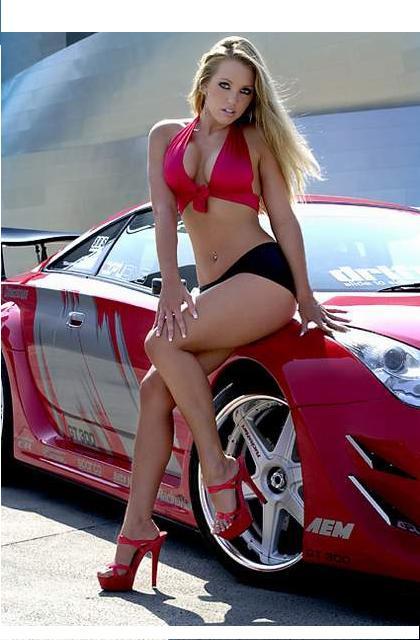
2012 Tokyo Auto Salon : Toyota Prius GT300 Race Car is Mean and Green

2012 Tokyo Auto Salon : Toyota Prius GT300 Race Car is Mean and Green


Racing a Prius might sound like the start of a joke, until you see this. Unveiled at the Tokyo Auto Salon in Japan, this Toyota Prius is fully prepped and sporting its race livery. Significantly wider and lower than a factor model, this Prius is designed to compete in Japan’s Super GT racing series starting this year.

Regulations in the series are loose, so there’s little left of the original Prius here, although the original’s sleek aerodynamic shape is still obvious. Also of note is that the car appears to retain a hybrid drivetrain with the Toyota Hybrid Synergy Drive logo on the back. Another hint is the massive sponsorship by Panasonic, which supplies the batteries for the road car.

Exactly how this hybrid racer will do remains to be seen and we’ll have to wait for the first round of the Super GT series in March to find out.


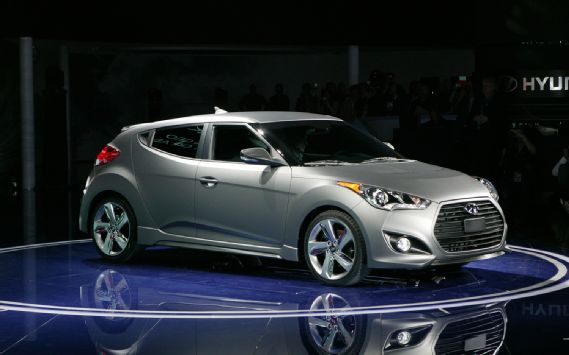
2013 More Power, Matte Paint: 2012 Detroit Auto Show. Hyundai Veloster Turbo

2013 More Power, Matte Paint: 2012 Detroit Auto Show 2013 - Hyundai Veloster Turbo


 We’ve already been given details on Hyundai‘s upcoming Veloster Turbo, now we’ve actually seen it in the flesh. Unveiled at the 2012 North American International Auto Show in Detroit, the car is projected to go on sale this summer and sports a blown and intercooled version of the 1.6-liter, direct injected Gamma four-cylinder under the hood.

Rated at 201 horsepower and 194 lb-ft of torque (across a wide 1750 to 4500 rpm spread) the motor sports a twin-scroll turbocharger contained within a housing integrated with the exhaust manifold, designed to improve throttle response and promote lower combustion chamber temperatures, plus a motor driven electrical wastegate and compact side-by side configuration intercooler. Dished pistons with cooling jets and a low friction valvetrain are also employed for durability.

Besides the choice of six-speed manual and six-speed dual clutch automatic transmissions, quicker ratio steering, unique body pieces and special 18-inch wheels shod in Kumho 215/40ZR/18 tires promise to make the Veloster quite an entertaining machine to drive, in view of its 2,800 lb curb weight, which is 77 lbs less than the Honda Civic Si coupe and 237 less than the VW GTI.

Inside, the Veloster Turbo comes with standard heated front seats and dual TFT screens between the speedometer and rev counter, designed to keep the driver informed of what’s going on at all times.

For those that can’t wait until August, Hyundai also released the virtual Veloster Turbo for Forza Motorsport 4 at the same time the actual car made its world debut, giving both gamers and enthusiasts alike, a chance to have some fun with Hyundai’s latest sporty offering before it actually goes on sale.


Supercar Concept America’s Falcon F7 Debuts In Detroit: Pictures

Supercar Concept America’s Falcon F7  Debuts In Detroit: Pictures

We first brought you details on the Falcon F7 supercar a year ago but now the company behind it, America’s own Falcon Motorsports, has unveiled a new concept version at a special presentation in Detroit.

Falcon claims that its latest concept shows the look of the production F7 supercar due out later this year.


Finding buyers shouldn’t be too difficult for Falcon considering its F7 supercar packs a 7.0-liter LS7 tuned to deliver more than 620 horsepower and 600 pound-feet of torque. Remember, the entire thing weighs just 2785 pounds so performance should be scintillating.

Drive is sent to the rear wheels only via a six-speed Ricardo transaxle, just like in the Ford GT, and acceleration for the F7 takes just 3.3 seconds to go from 0-60 mph. Top speed is an estimated 200 mph.

The body is composed entirely of carbon fiber, while much of the internal structure is aluminum. Falcon uses its own hydroformed tube chassis for the F7, with suspension components lifted from the Chevrolet Corvette.


Falcon Motorsports, as some readers may recognize, is a company located in Michigan that specializes in building bodykits and other modifications for the Dodge Viper. Now the firm has used its talents to build its own supercar, which will be priced around $225,000 and sell in numbers as high as 20 units annually if enough buyers can be found.


First Drive Review by Simraceway

Simraceway First Drive Review

Racing, track days, and other forms of four-wheeled motorsports are tremendous fun; that's something many of us understand first-hand. But some of us don't have the time or the budget to dedicate to getting a real car on a real track. For some, simulators are as close as they can get on a regular basis. Fortunately for them, simulators have come a long way in the last several years.


But in the serious sim community, particularly among those who also race in the real world, there's one brand that has risen to the top: iRacing. It has done so through a combination of marketing, building a solid product, and a subscription service model that allows a high degree of realism to be had for not too much money--up front, anyway. The ongoing monthly fee is still cheap compared to race tires, brake pads, and engine rebuilds, but when you throw in a dozen cars and tracks, the amount of money invested in the sim can quickly rise into the hundreds of dollars.

Enter Simraceway, the first racing game with a real-world driving facility. Partnered from the start with the Jim Russell Racing Drivers School (which now shares its name with the sim: Simraceway Performance Driving Center), it aims to take on the needs and desires of real racers, aspiring racers, and hardcore sim drivers in addition to more casual gamers by providing even more realism. How does it do this? By involving real racing drivers, instructors, and car manufacturers in the very structure of the sim, and bringing it all together in a convenient, subscription-free online racing environment.

Building custom models of the cars, tires, and physics to replicate the experience of really driving a huge range of cars and tracks, the Simraceway team is adding content almost daily. Just this week, the Dodge Viper ACR-X joined a roster of cars over a dozen deep. The 2011 McLaren F1 car will be joining the list soon. Other cars already available include:

    * Maserati MC12
    * McLaren M6 GT
    * Alfa Romeo 8C
    * BMW 1-Series M Coupe
    * Bentley Continental Supersports
    * Morgan 3 Wheeler
    * BMW E92 M3 GT2
    * Simraceway Formula 3 (the same car used at the school)
    * Mitsubishi Lancer Evolution X (also used at the school)
    * BMW Z4 GT3
    * Dodge Charger R/T


Dozens more cars are on their way, including an exclusive batch of McLarens and many cars yet to be announced.

In other words, whether you're into lapping the latest sedans, formula cars, and track-bred production vehicles or some of history's most impressive vintage hardware, or even hyper-luxury sports tourers, Simraceway has something for everyone, or will have it soon.

The core of the game may appear familiar to some, though Simraceway has built an entirely custom interface in addition to the custom models, physics, and tracks. That's because the game's engine is the same as that used in rFactor, one of the ground-breakers in realism among modern simulators, and well-known for its openness to community customization and modification.

To start racing, you just download the game and install it, then sign up with the Simraceway.com website. Once you have an account, you'll get the Mitsubishi Evolution X included with the game and a handful of tracks to drive on. While the web interface isn't as polished as iRacing's, a nice feature is that you can opt to join races from either the browser-based account management page, or from within the sim itself.

For that matter, once you've added some credits or cash to your account, you can buy cars from either portal as well.

But lets get down to what really matters: how does it drive?

Very well, actually. It seems as if the track maps aren't quite as detailed as iRacing's, in terms of surface conditions and anomalies, though they are more than simple billiard-smooth paths along a course map; there are undulations, bumps, ripples, and rubbered-in lines, all of which affect grip, the car's attitude, and the line you'll have to take. The cars feel noticeably different from one to the next. We've driven many of the available cars in real life, and we can confirm they behave much like their real-world counterparts, insofar as any 2D screen and controller can replicate the feel of driving an actual car.

Off-track items aren't quite as detailed as most iRacing tracks, but if you're looking at the scenery, you're missing the point anyway, and the tracks themselves offer plenty of visual cues, character, and detail. At the same time, having more detailed items in your peripheral vision can add to the sense of immersion, which can enhance the sim experience. Here, Simraceway comes up a bit short, even with all settings turned to maximum, but not so much as to bring the overall driving value down meaningfully.


Related Posts Plugin for WordPress, Blogger...